

Implementing the Electronic Medical Record: A Practical Series (1)

I spent a few months on the move after my assignment at King Fahad Specialist Hospital in Dammam came to an end. At times my passion drew me toward medical consulting in digital health; at other times I wanted to join a national entity leading the future of digital health. Either way, my passion for informatics never fades!
I have recently landed — or perhaps only temporarily? — at King Fahad Medical City, full of curiosity to gain both knowledge and hands-on skills in the methodology of "Epic", as I like to call it — one of the world's leading companies in Electronic Medical Records — and to sharpen my skills in implementing projects of this kind and scale!
In a previous article, I described the tasks that health informatics specialists — physicians and others — undertake to arrive at a comprehensive picture and view of health. Foremost among these tasks is implementing electronic medical record projects in healthcare facilities, since this is the cornerstone and first building block in the journey of sound medical information. Because this area is deep and multifaceted, I chose to begin this series of diaries here!
Discussion of the implementation phase is usually preceded by the more important phase: planning and preparation. This phase can take months, and sometimes even years, depending on the size of the healthcare facility and the scale of change. I may skip this part in this diary to get straight to the heart of the matter, and return to it in another entry.
I will not talk about what electronic medical records are, nor about the national strategies for reaching the strategic goal of a unified health record, and — most importantly — not about Epic as a vendor. I am not trying to market them in the first place, and I hope I don't catch "Epic fever" given the professionalism I have seen in the implementation of this project so far.
I also think it is fitting to begin a series of diaries dedicated to the many aspects of this experience, which most of my informatics colleagues regard as unique. So I will focus on the lessons I am learning every day from this implementation, on a project of this magnitude — lessons we have not learned, and will not learn, in "theoretical" classrooms! And to try to keep my thoughts organized — I hope I manage that in these diaries — I will give each diary a particular theme, or the key takeaway that I want to make sure I remember well.
Lesson Learned #1
Guiding Principles
On my first day working with the informatics team at King Fahad Medical City, I went straight to the notice board, which was covered with scattered sheets of paper, and in the middle was the heading Guiding Principles for a Successful Implementation! I did not expect to see this list so soon. I was still trying to explore the dimensions of time and place of this project — in fact, I was still getting to know its most important resource, the current and future engine of the implementation: human capital, the team itself!
I read the list carefully, and the first point was the most profound for me; it became my message and lesson of the day! In every meeting, some of these principles are mentioned, and at the top of them is that implementing electronic medical record projects is a clinical transformation project, not merely a "technical" transformation project!
This sentence alone is perhaps the best description of "digital health" projects in general.
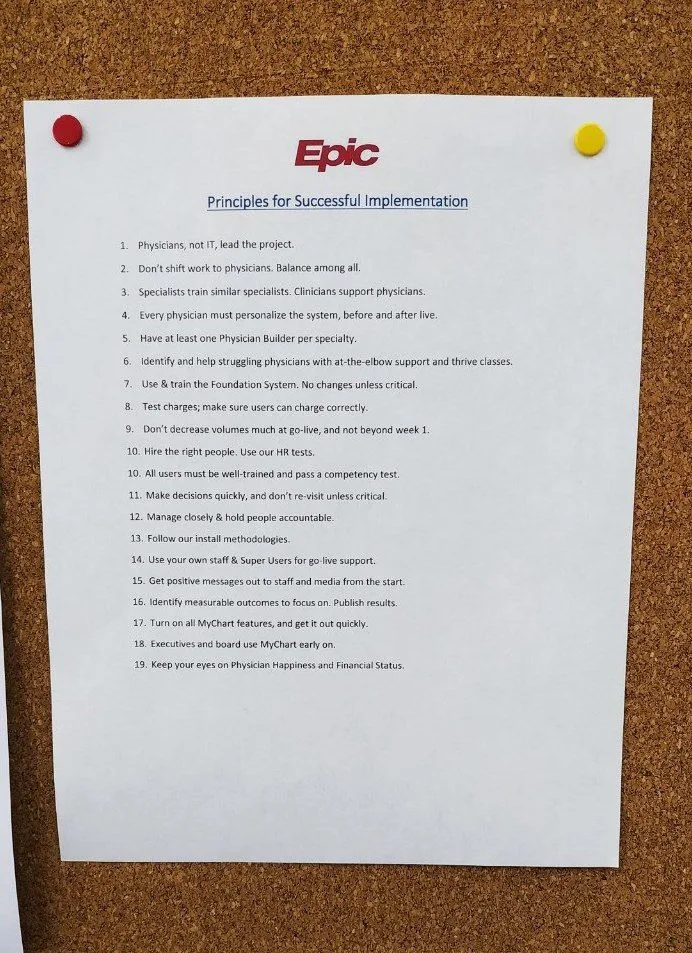
Example: principles for a successful implementation, which vary greatly from one facility and one implementation project to another
What does having guiding principles actually mean? And why should we care?!
When we look at technology projects that require working with users of varying experience and ages — especially when the change is comprehensive and complex — it becomes essential to have a constitution or agreement among all members of the facility/organization, built around a set of principles. These principles usually serve as the deciding factor whenever disagreements arise over final decisions at the level of a department or administration directly affected by the change.
I may be biased in saying that the healthcare work environment is highly complex compared to other service sectors, owing to many factors — chief among them the wide spectrum of health specialties and the way they work as interconnected teams within the same facility. You can see this variation simply by looking at the number of specialists in a single field, from physicians to a full multidisciplinary medical team.
Imagine with me a single change — such as adding a new signature requirement from the attending physician — and how it would affect the workflow within that team, turning this intervention into a bottleneck and a cause of work piling up before the necessary procedures can be completed. Now, how would it look to rebuild most of the current workflows and procedures as part of an electronic medical record implementation, regardless of the vendor?!
Over the past few weeks, I have witnessed many conflicts between medical teams from various specialties over changes like these to workflows, and what must be done to approve them once the design and build phase began in preparation for the final go-live! That is why these principles are always the starting point of any meeting, presentation, or proposal to change a workflow — because the goal here is not merely to implement this project, but to make it succeed in its true purpose: making medical practice safer, more efficient, and, in most cases, easier for the healthcare professionals and administrators who work with it in the facility. Agreeing on this constitution is one of the most important elements of change management across the various phases a project of this magnitude goes through.
As a live example, during the most recent meeting of one of the project's steering committees, one of these principles was: (All decisions of this committee are final). This genuinely made the meetings more productive. If certain decisions were too big for this committee to make, they were removed from the meeting agenda until senior and/or relevant leadership decided on them, and they were not discussed until they fell within the scope of this core principle.
That is on a small scale, within a single steering committee. What is fascinating here is applying these principles across all levels of project management, all the way up to the governing bodies that determine the fate of the healthcare facility as a whole, giving direction and clarity in decision-making no matter how critical the decisions are.
In this diary I have talked about "Epic" and this practice, which other vendors may also follow. To confirm the importance of this lesson, I consulted good old Google to look for similar cases and found several examples that made these principles the centerpiece of the entire clinical transformation process, with the electronic medical record serving merely as an enabling tool — not the other way around!
Here is a sample of these examples:
3. Columbia University Irving Medical Center
And many others that have not been published or cannot be published.
Guiding principles — whether long or short — are one of the key enablers of governance capable of reaching practical decisions at the organizational level. The introduction of digital enablement and change tools, or any others, should be guided by these principles from the outset. Having senior leadership prepare, draft, and agree on them — carefully defined at an early stage of the project — is one of the success factors of any change project!


Comments
No comments yet. Be the first.